
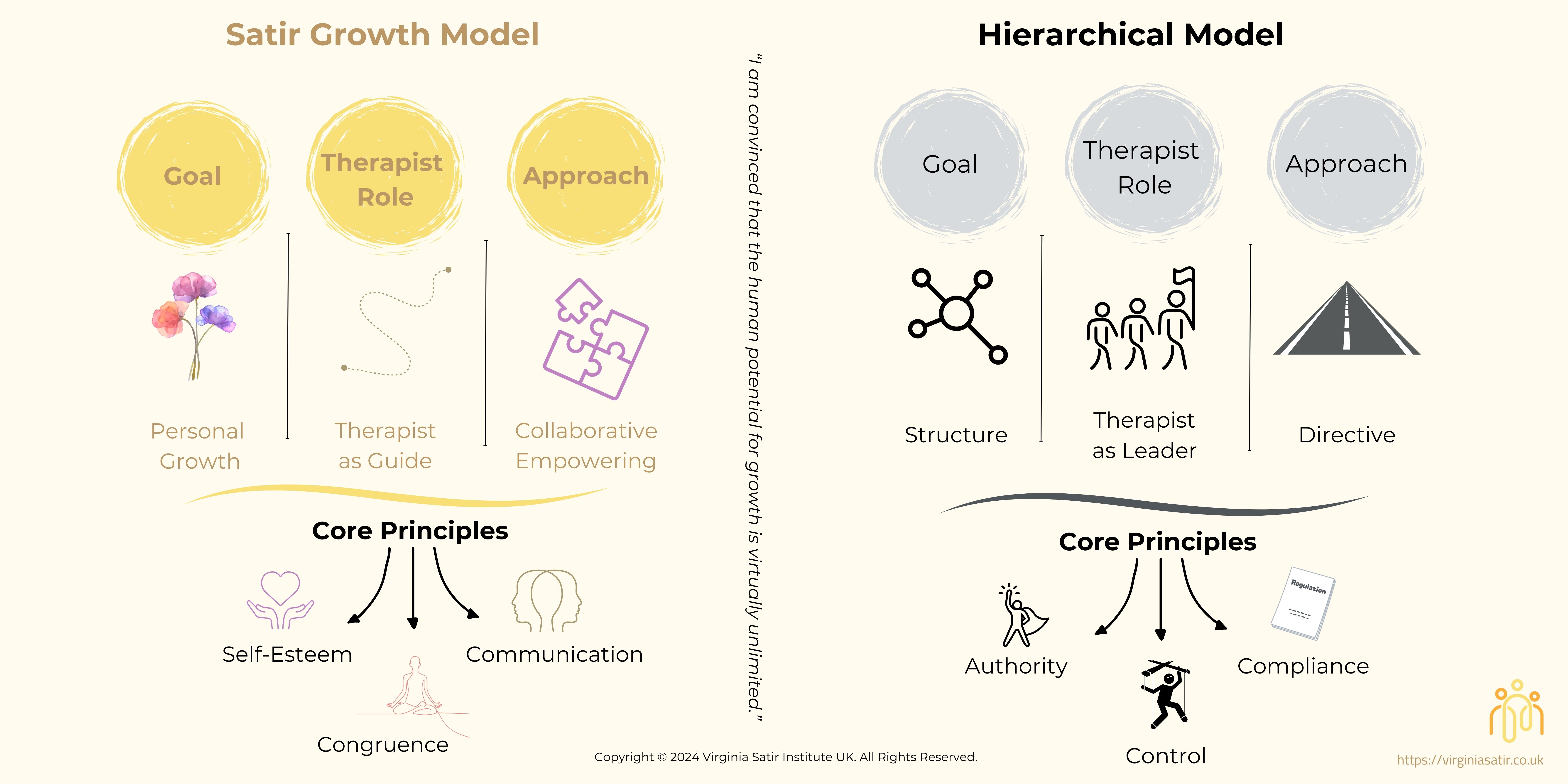
Many people come to therapy with the same quiet hope:
“I want something to change — I just don’t know how.”
They’ve read the books.
They understand their patterns.
They can often explain exactly why they behave the way they do.
And yet, something remains stuck.
From a Satir perspective, this isn’t a failure of insight or effort.
It’s a misunderstanding of how change actually happens.
Change Is Not a Problem to Solve
In many modern approaches, change is framed as correction:
identify the faulty behavior, challenge it, replace it.
But Virginia Satir offered a very different lens.
She believed that people are not problems to be fixed — they are systems shaped in relationship.
And systems don’t change through force.
They change through experience.
This is the foundation of the Satir Growth Model.
Rather than focusing on symptoms alone, the model invites us to look beneath behavior — toward self-worth, communication, and the internal experience shaping our choices.
Self-Worth: The Ground Beneath All Change
At the heart of the Satir Growth Model is a simple, radical idea:
When self-worth is supported, growth follows naturally.
Self-worth is not something we “build” through achievement or perfection.
It is something we experience when we feel seen, heard, and validated — especially within our earliest relationships.
When that validation is inconsistent or absent, the system adapts.
People learn to:
- stay quiet
- stay strong
- stay pleasing
- stay reasonable
- stay invisible
These are not flaws.
They are protective strategies.
The difficulty arises when these strategies remain long after the conditions that shaped them have changed.
Why Understanding Isn’t Enough
Many people reach a point where they can clearly see their patterns.
They know why they avoid conflict.
They know why they over-function.
They know where their self-doubt began.
And still, nothing shifts.
From a Satir lens, this makes sense.
Insight speaks to the mind.
Change requires the whole system — emotional, relational, embodied — to feel safe enough to reorganise.
Without new experiences of validation, clarity, and congruence, old patterns continue doing what they were designed to do: protect.
Communication and Congruence
Satir placed great emphasis on congruence — the alignment between what we feel, think, and express.
When communication is incongruent, people often speak from protection rather than truth:
saying “I’m fine” when they’re overwhelmed
becoming logical when emotions feel unsafe
withdrawing instead of asking for support
Congruence is not about saying everything.
It’s about being real — internally and externally — without abandoning oneself or others.
As communication becomes clearer and more empathic, the system softens.
Choice returns.
Growth Happens Through Support, Not Pressure
One of the most misunderstood aspects of growth is the belief that change requires pressure.
From a Satir perspective, pressure often reinforces the very patterns people are trying to move beyond.
Growth happens when:
self-worth is validated rather than questioned
patterns are understood rather than judged
communication becomes clearer and more compassionate
old roles are explored with curiosity instead of blame
Under these conditions, parts of the system no longer need to protect so fiercely.
They can rest.
And when they rest, change becomes possible.
Why Real Change Starts From Within
The Satir Growth Model reminds us that lasting change is not imposed from the outside.
It emerges from within — when people feel safe enough to explore, express, and choose differently.
This is not fast work.
It is not performative.
And it cannot be rushed.
But it is deeply stabilising.
When people grow in self-worth, their relationships change.
When communication becomes congruent, conflict softens.
When old patterns are met with compassion, new possibilities appear.
This is the kind of change that lasts — not because it was forced, but because it was supported.
And that, perhaps, is the most radical idea of all.