
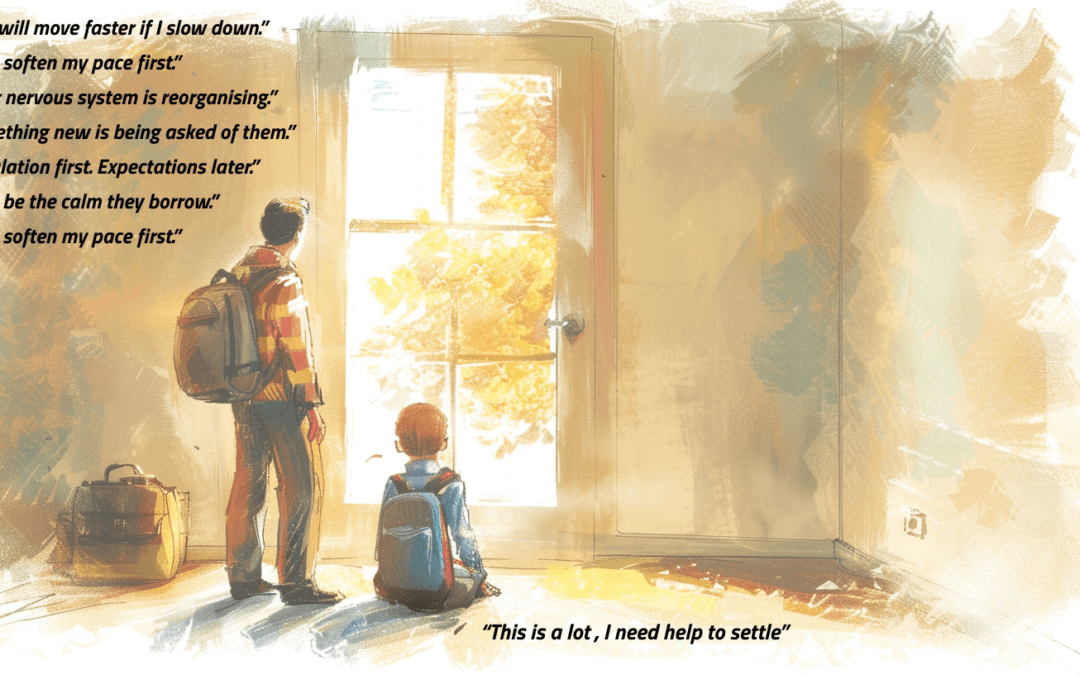
Every September, many parents notice a familiar pattern.
Children who were relatively calm over the summer begin to:
- push back
- melt down more easily
- seem irritable, distracted, or defiant
- struggle with routines they’ve followed before
The instinctive interpretation is often behavioral:
“They don’t want rules.”
“They’re testing limits.”
“They need more discipline.”
But from a psychological and systemic perspective, this misses something essential.
Children are rarely resisting structure itself.
They are responding to nervous-system overload during transition.
Transition Is Stress — Even When It’s “Positive”
September is a month of massive transition.
New schedules.
Earlier mornings.
Increased cognitive demands.
Social re-entry.
Performance expectations.
Even when children like school, their systems still have to reorganize.
For adults, transitions are challenging.
For children — whose nervous systems are still developing — transitions are even more demanding.
What often shows up as “acting out” is actually the system saying:
This is a lot. I need help to settle.
Regulation Comes Before Cooperation
One of the most misunderstood principles in child development is this: Regulation precedes cooperation.
A child who is dysregulated cannot reliably:
- listen
- comply
- concentrate
- self-control
No amount of explanation or consequence can override a nervous system that is already overloaded.
When parents try to increase control in these moments, children often escalate — not because they are oppositional, but because their system feels pushed rather than supported.
Children Mirror the Family System
Children do not re-enter September alone.
Parents are also transitioning:
back to work rhythms,
back to responsibility,
back to pressure.
Children are exquisitely sensitive to this shift.
They pick up on:
- urgency
- impatience
- unspoken stress
- emotional tightening in the household
From a systemic lens, children often carry the transition stress of the family — expressing what the system itself hasn’t yet settled.
This doesn’t mean parents are doing something wrong.
It means families are reorganizing together.
What Helps More Than Rules
Structure matters.
Boundaries matter.
But timing matters too.
In early September, children need:
- predictability with warmth
- routines introduced gradually
- connection before correction
- adults who can regulate themselves first
This doesn’t mean removing structure.
It means leading with regulation, so structure can land.
When children feel safe enough, cooperation follows naturally.
Not immediately.
Not perfectly.
But steadily.
Reading Resistance as Information
Instead of asking:
“How do I stop this behavior?”
September invites a different question:
“What is this behavior telling me about what the system needs right now?”
Seen this way, resistance becomes information — not a problem to eliminate, but a signal to interpret.
And when families respond at the level of the nervous system, not just behavior, September becomes less of a battle — and more of a settling.
Not because children suddenly “behave better,” but because the system finally feels supported enough to reorganize.